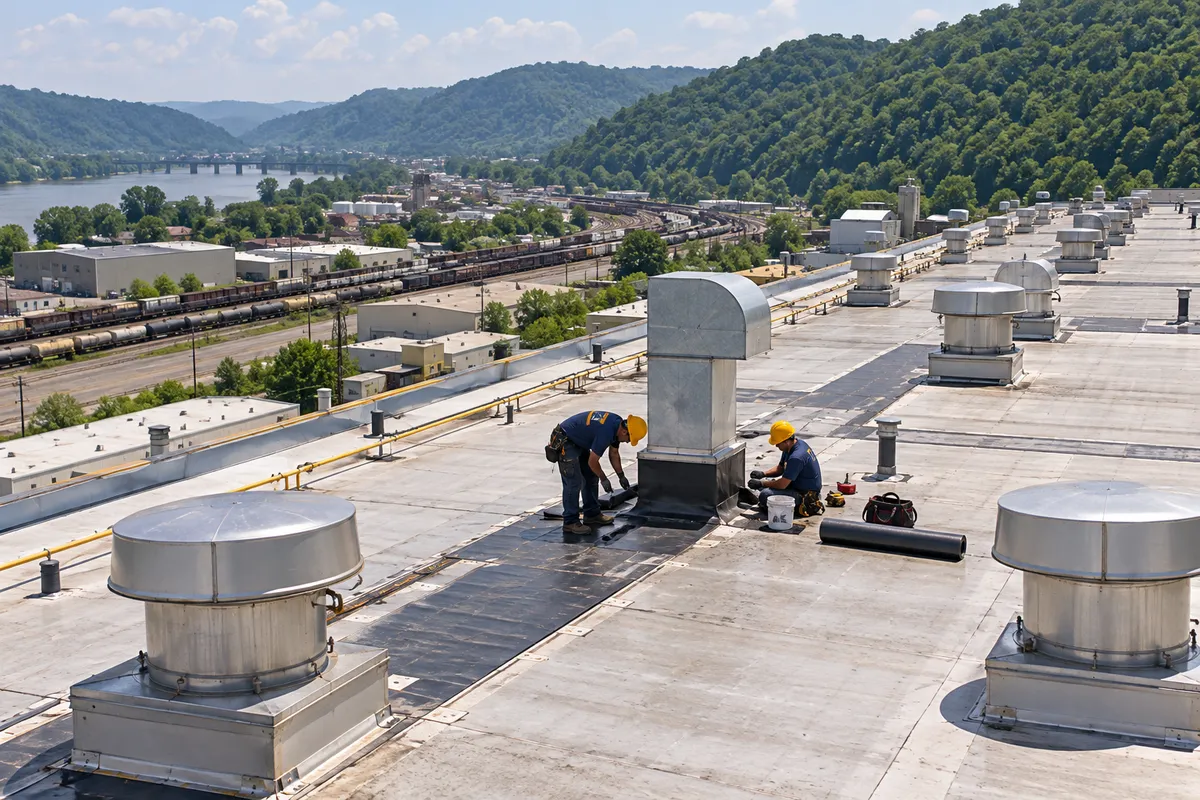
Backed-Out Screws
Daily expansion pushes screws up and cracks their washers, opening a hole at every purlin line on R-panel roofs. The next screw size up with a new washer closes it.
Standing Seam And R-Panel
As an Ashland commercial metal roofing contractor, we install, repair, and maintain standing seam and R-panel steel on shops, plants, offices, and farm buildings.
Is This Roof A Fit?
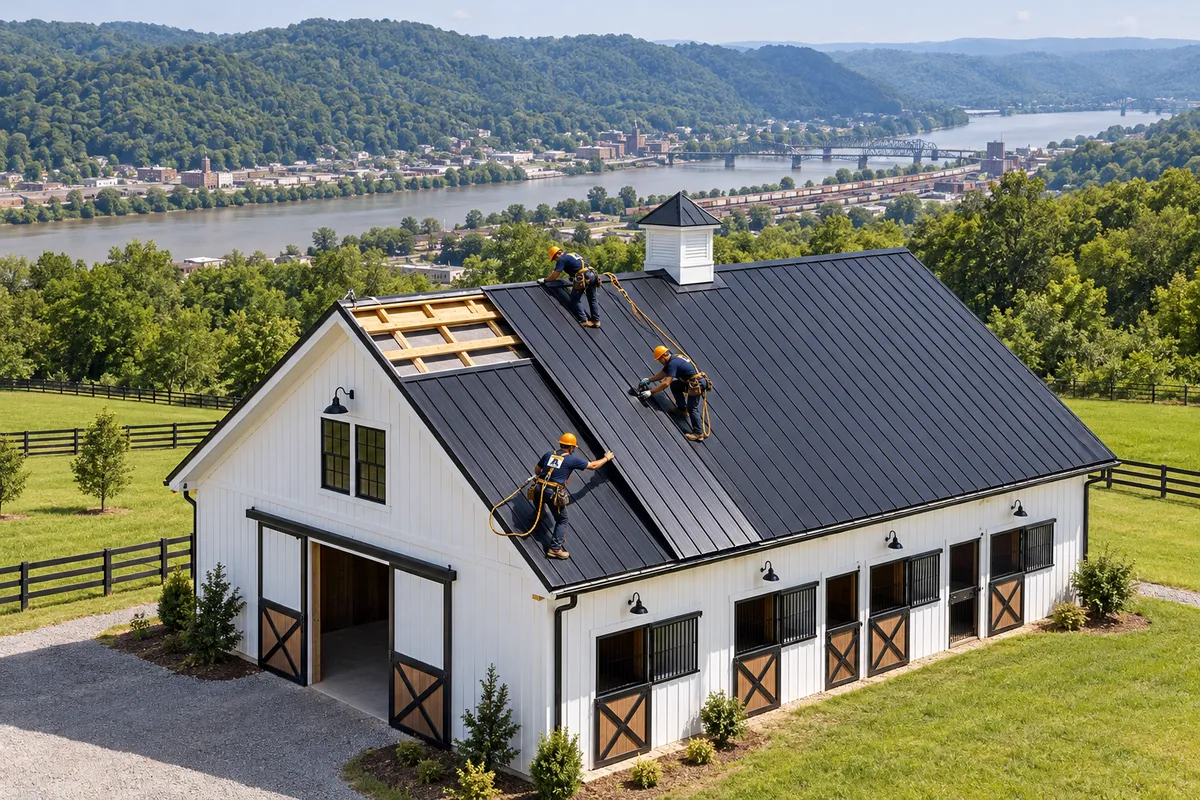
As your Ashland commercial metal roofing contractor, we fit metal to pitched roofs and retrofit framing over failing flat roofs. These checks come first.
| Factor | Good Fit | Fix First Or Look Elsewhere |
|---|---|---|
| Roof pitch | Enough slope for the panel, per the maker | Nearly flat roofs without retrofit framing |
| Structure | Purlins and framing that carry the load | Rusted purlins or added load the structure cannot take |
| Existing panels | Surface rust, solid steel | Panels holed through or bent across many bays |
| Inside conditions | Vapor retarder planned on heated space | Heated shop with bare steel and no retarder |
| Edges and walls | Trim and wall flashing that can be reset | Masonry walls with no counterflashing line |
Roof Conditions
Steel roofs leak at the same handful of places. Each one has a specific repair.
Daily expansion pushes screws up and cracks their washers, opening a hole at every purlin line on R-panel roofs. The next screw size up with a new washer closes it.
At the overlap between panels, dried butyl tape lets water creep up the lap and drip inside. New tape and stitch screws reseal it.
Panels rusted through or holed by a falling limb need replacing with the same profile and gauge. The panel slides in under the laps.
Heated shops with bare steel drip on cold mornings in the humid Ohio River valley, which looks like a leak. A taped vapor retarder stops it.
Where a metal roof meets a taller masonry wall, water runs down the joint unless a counterflashing is cut into the wall. That cut closes the leak line.
Leaves pack gutters in fall, freeze solid, and push meltwater back over the eave and under the panels. Fall cleaning prevents it.
Options
Metal work covers new roofs, retrofits, and keeping existing steel roofs tight.
Concealed clips let long panels float as they expand, which suits large warehouse roofs, offices, and schools.
Exposed-fastener steel for shops, barns, storage, and plants, commonly 26 gauge over Galvalume with an SMP finish.
Light steel framing builds slope over a failing flat roof, and new panels span across it after an engineer checks the load.
Screws replaced one size up, laps resealed with butyl and stitch screws, and curb and wall trim reset with new closures.
Benefits
Steel roofs on the right building hold up well, as long as the parts under and around the panels are right.
Floating clips on standing seam let long runs expand and shrink every day without working screws loose.
A taped vapor retarder on the warm side keeps damp indoor air off cold steel, ending the winter drip.
Eave and rake trim and a ridge cap over profiled closures hold panel ends and keep blowing rain out.
Curb flashing with an upslope cricket moves water around rooftop units instead of into the curb.
A warning from NWS Charleston that mentions wind or hail is the cue for a roof walk. Call and we will check screw lines, trim, and laps.
Process
New roofs, retrofits, and repairs all start on the roof and inside the building.
We walk the panels, screw lines, laps, and trim, and check purlins, insulation, and condensation signs from inside.
Findings set the path: repair, new panels on the same frame, or retrofit framing over a flat roof.
Insulation, a taped vapor retarder, and underlayment over solid decks go down before any panel.
Panels go on with clips or screws, then ridge cap, eave and rake trim, closures, and curb flashing.
A final walk checks every screw line and lap, and a log records what was set or fixed.
Related Services
Metal roofs often sit beside flat sections, or need repairs before anything new.
Leaks at a few laps or screw lines get fixed now, while a replacement is planned.
Commercial Roof RepairPlants mixing metal high bays and membrane additions need both tied together cleanly.
Industrial RoofingQuestions
More answers are on the commercial roofing FAQ.
Condensation
Warm, damp indoor air condenses on cold bare steel. In the humid Ohio River valley that happens often in heated shops.
Faced insulation or a vapor retarder with taped seams on the warm side stops it. During a reroof, that layer goes in before the new panels.
Panels
Standing seam hides its clips under raised seams and floats as it expands, which suits offices, schools, and big warehouses. R-panel screws straight through into the purlins and suits shops, barns, and storage.
A lower gauge number means thicker steel.
Retrofit
Yes, with retrofit framing that builds slope over the old membrane. It suits roofs with chronic ponding and many past patches, if the structure carries the load.
An engineer checks it first, and gutters often replace interior drains.
Underlayment
Faced insulation or rigid board, a vapor retarder on the warm side, and underlayment over a solid deck. Eave and rake trim, ridge cap over closures, and curb flashing finish the edges.
Repair
Backed-out screws come out and the next size up goes in with a fresh washer. Holed panels are swapped for the same profile, and leaking laps get new butyl tape and stitch screws.
Rusted purlins turn it into structural work.
Maintenance
Walk it twice a year and after any wind or hail warning. Clear gutters and valleys, pick up debris, look for raised screws, check sealant at boots and curbs, and log what you find.
Fall gutter cleaning matters most.
Tell us the building type, the panel on it now, and where it leaks. A roof walk and a look inside come first.